
Governing under Pressure: Institutions, Vulnerability, and Political Change in Contemporary Indonesia and Asia
EDITORS' INTRODUCTION
DOI:
https://doi.org/10.15575/jispo.v16i1.59459Keywords:
Governing under Pressure, Institutions, vulnerability, Political ChangeAbstract
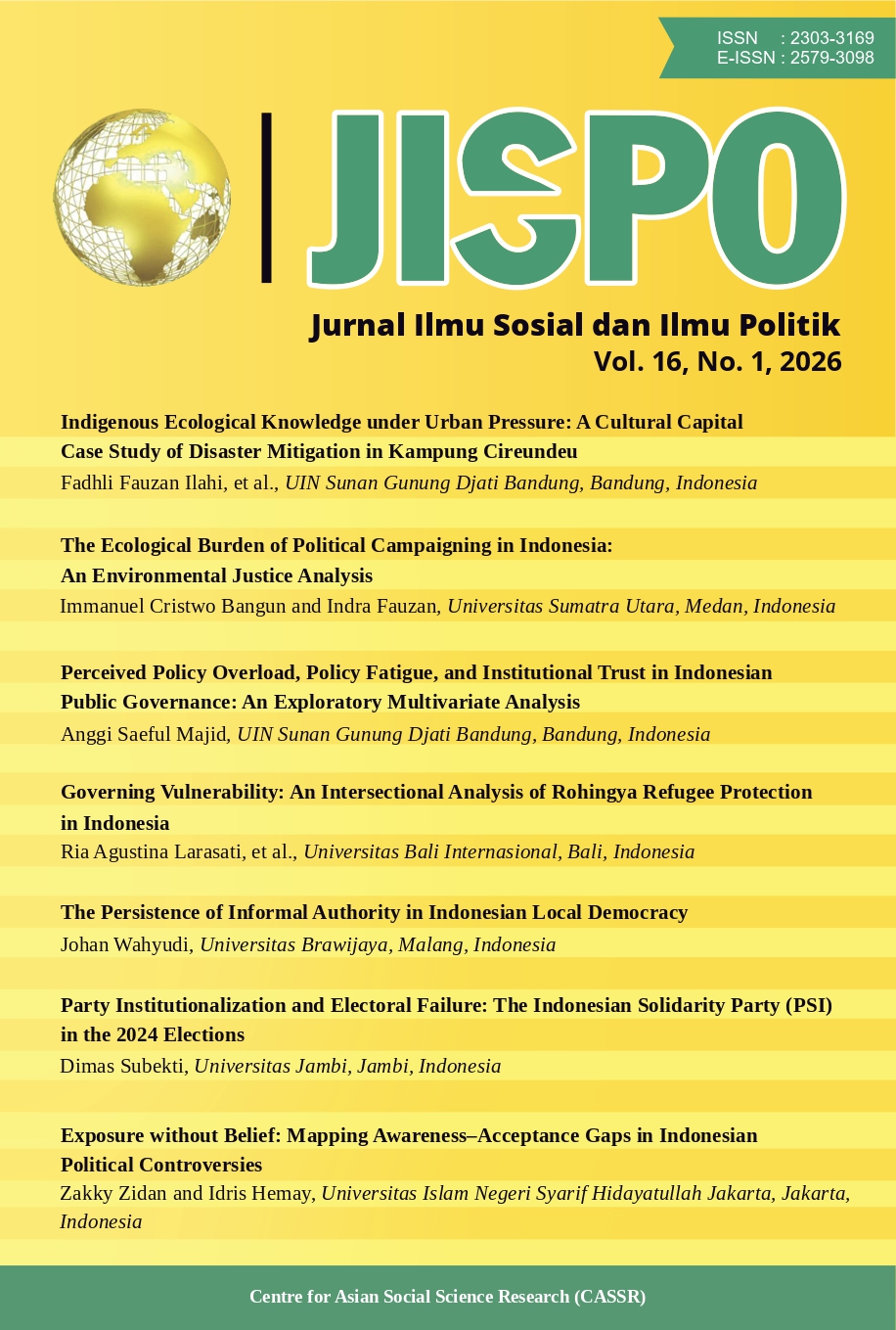
JISPO Vol. 16 No. 1 (2026) brings together a diverse set of studies examining how institutions, political actors, communities, and vulnerable groups navigate pressures arising from environmental change, governance challenges, electoral competition, and shifting forms of political authority in contemporary Indonesia and the wider Asian context. Framed by the theme “Governing under Pressure: Institutions, Vulnerability, and Political Change in Contemporary Indonesia and Asia,” the issue explores indigenous ecological knowledge in disaster mitigation, the environmental burden of political campaigning, policy overload and institutional trust, the protection of Rohingya refugees, the persistence of informal authority in local democracy, party institutionalization and electoral failure, and the gap between public awareness and acceptance of political controversies. Taken together, these contributions highlight the complex interaction between formal institutions, social vulnerability, environmental pressures, and political change, while demonstrating the value of interdisciplinary perspectives for understanding contemporary governance and democratic dynamics.
References
Asian Development Bank. 2024. Disaster Risk Management Action Plan 2024–2030: Redoubling Action Toward Disaster Resilience. Manila: Asian Development Bank. doi:10.22617/SPR240615-2.
Association of Southeast Asian Nations. 2026. ASEAN Work Plan for Information and Media 2026–2035. Jakarta: ASEAN Secretariat.
Davidson, Jamie S., and David Henley, eds. 2007. The Revival of Tradition in Indonesian Politics: The Deployment of Adat from Colonialism to Indigenism. London: Routledge.
Gaillard, J. C., and Jessica Mercer. 2013. “From Knowledge to Action: Bridging Gaps in Disaster Risk Reduction.” Progress in Human Geography 37 (1): 93–114. doi:10.1177/0309132512446717.
Halling, Aske, and Martin Bækgaard. 2024. “Administrative Burden in Citizen–State Interactions: A Systematic Literature Review.” Journal of Public Administration Research and Theory 34 (2): 180–195. doi:10.1093/jopart/muad023.
Herd, Pamela, and Donald P. Moynihan. 2018. Administrative Burden: Policymaking by Other Means. New York: Russell Sage Foundation. doi:10.7758/9781610448789.
International IDEA. 2025. The Global State of Democracy 2025: Democracy on the Move. Stockholm: International Institute for Democracy and Electoral Assistance. doi:10.31752/idea.2025.53.
Kneebone, Susan, Reyvi Mariñas, Antje Missbach, and Max Walden, eds. 2025. Refugee Protection in Southeast Asia: Between Humanitarianism and Sovereignty. Berghahn Books. doi:10.2307/jj.16275978.
Mercer, Jessica, Ilan Kelman, Lorin Taranis, and Sandie Suchet-Pearson. 2010. “Framework for Integrating Indigenous and Scientific Knowledge for Disaster Risk Reduction.” Disasters 34 (1): 214–239. doi:10.1111/j.1467-7717.2009.01126.x.
Mietzner, Marcus. 2013. Money, Power, and Ideology: Political Parties in Post-Authoritarian Indonesia. Singapore: NUS Press.
Missbach, Antje. 2017. “Accommodating Asylum Seekers and Refugees in Indonesia: From Immigration Detention to Containment in ‘Alternatives to Detention.’” Refuge: Canada’s Journal on Refugees 33 (2): 32–44. doi:10.7202/1043061ar.
Moynihan, Donald, Pamela Herd, and Hope Harvey. 2015. “Administrative Burden: Learning, Psychological, and Compliance Costs in Citizen–State Interactions.” Journal of Public Administration Research and Theory 25 (1): 43–69. doi:10.1093/jopart/muu009.
OECD and Asian Development Bank. 2025. Government at a Glance: Southeast Asia 2025. Paris: OECD Publishing. doi:10.1787/bc89cb32-en.
Pennycook, Gordon, Tyrone D. Cannon, and David G. Rand. 2018. “Prior Exposure Increases Perceived Accuracy of Fake News.” Journal of Experimental Psychology: General 147 (12): 1865–1880. doi:10.1037/xge0000465.
Pennycook, Gordon, and David G. Rand. 2021. “The Psychology of Fake News.” Trends in Cognitive Sciences 25 (5): 388–402. doi:10.1016/j.tics.2021.02.007.
Power, Thomas, and Eve Warburton, eds. 2020. Democracy in Indonesia: From Stagnation to Regression? Singapore: ISEAS–Yusof Ishak Institute.
Seo, Ji Hoon. 2025. “Toward Sustainable Election Campaigns: Addressing Microplastic Pollution from Promotional Materials.” Science Progress 108 (4). doi:10.1177/00368504251397431.
Taniady, Vicko, Reni Putri Anggraeni, and Ahmad Alveyn Sulthony Ananda. 2024. “Strategi Perlindungan Pohon pada Tahapan Kampanye Pilkada 2024.” Electoral Governance: Jurnal Tata Kelola Pemilu Indonesia 5 (2): 159–182. doi:10.46874/tkp.v5i2.1238.
Ufen, Andreas. 2008. “Political Party and Party System Institutionalization in Southeast Asia: Lessons for Democratic Consolidation in Indonesia, the Philippines and Thailand.” The Pacific Review 21 (3): 327–350. doi:10.1080/09512740802134174.
United Nations Economic and Social Commission for Asia and the Pacific. 2025. Rising Heat, Rising Risk: Policy Pathways for Regional Resilience. Asia-Pacific Disaster Report 2025. Bangkok: United Nations.
United Nations Environment Programme and International Solid Waste Association. 2024. Global Waste Management Outlook 2024: Beyond an Age of Waste—Turning Rubbish into a Resource. Nairobi: United Nations Environment Programme. doi:10.59117/20.500.11822/44939.
United Nations High Commissioner for Refugees. 2026. “UNHCR: 2025 Was Deadliest Year Yet for Maritime Movements of Rohingya Refugees.” April 17.
von Benda-Beckmann, Franz, and Keebet von Benda-Beckmann. 2013. Political and Legal Transformations of an Indonesian Polity: The Nagari from Colonisation to Decentralisation. Cambridge: Cambridge University Press.
Downloads
Published
How to Cite
Issue
Section
Citation Check
License
Copyright (c) 2026 Asep Muhamad Iqbal

This work is licensed under a Creative Commons Attribution-ShareAlike 4.0 International License.
Authors who publish their manuscripts in JISPO agree to the following terms:
- Authors retain copyright and grant the journal right of first publication with the work simultaneously licensed under a Creative Commons Attribution-ShareAlike 4.0 International License that allows others to share the work with an acknowledgment of the work's authorship and initial publication in this journal;
- Authors are able to enter into separate, additional contractual arrangements for the non-exclusive distribution of the journal's published version of the work (e.g., post it to an institutional repository or publish it in a book), with an acknowledgment of its initial publication in this journal; and
- Authors are permitted and encouraged to post their work online (e.g., in institutional repositories or on their websites) after publication process, or prior to and during the submission process, as it can lead to productive exchanges, as well as earlier and greater citation of published work (See The Effect of Open Access).


.jpg)



