| People |
| Editorial Team Reviewers |
| Contact |
| Submissions |
| Author Guidelines |
| Reviewer Guidelines |
| Journal Template |
| Copyright Notice |
| Privacy Statement |
| Information |
| For Readers |
| For Authors |
| For Librarians |


JISPO: Jurnal Ilmu Sosial dan Ilmu Politik (2303-3169;2579-3089) is a SINTA 3-accredited, peer-reviewed, open-access academic journal that publishes original research articles and scholarly reviews across the social and political sciences, including sociology and social transformation, politics and international relations, public administration and public policy, and interdisciplinary social and political studies. The journal is dedicated to advancing theoretically informed, empirically grounded, and methodologically rigorous scholarship, with particular emphasis on Indonesia, Southeast Asia, and their connections to broader global developments. By connecting local social and political realities with international academic debates, JISPO seeks to contribute new perspectives on governance, democracy, social change, political institutions, and contemporary societal challenges. The journal welcomes contributions from scholars worldwide, particularly those offering comparative, interdisciplinary, and policy-relevant insights.
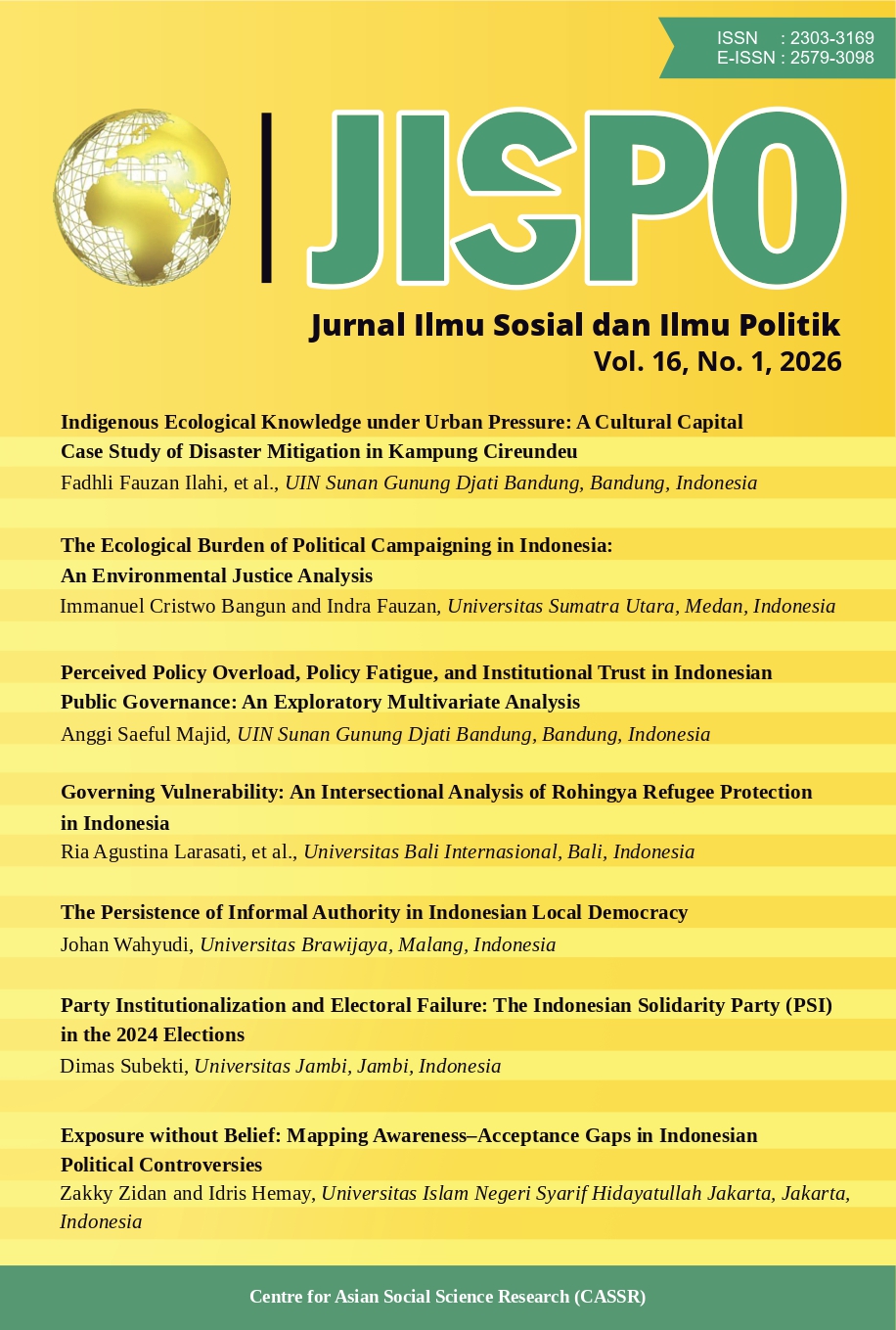
JISPO Vol. 16 No. 1 (2026) brings together a diverse set of studies examining how institutions, political actors, communities, and vulnerable groups navigate pressures arising from environmental change, governance challenges, electoral competition, and shifting forms of political authority in contemporary Indonesia and the wider Asian context. Framed by the theme “Governing under Pressure: Institutions, Vulnerability, and Political Change in Contemporary Indonesia and Asia,” the issue explores indigenous ecological knowledge in disaster mitigation, the environmental burden of political campaigning, policy overload and institutional trust, the protection of Rohingya refugees, the persistence of informal authority in local democracy, party institutionalization and electoral failure, and the gap between public awareness and acceptance of political controversies. Taken together, these contributions highlight the complex interaction between formal institutions, social vulnerability, environmental pressures, and political change, while demonstrating the value of interdisciplinary perspectives for understanding contemporary governance and democratic dynamics.
| People |
| Editorial Team Reviewers |
| Contact |
| Submissions |
| Author Guidelines |
| Reviewer Guidelines |
| Journal Template |
| Copyright Notice |
| Privacy Statement |
| Information |
| For Readers |
| For Authors |
| For Librarians |
Journal Indexing





