| People |
| Editorial Team Reviewers |
| Contact |
| Submissions |
| Author Guidelines |
| Reviewer Guidelines |
| Journal Template |
| Copyright Notice |
| Privacy Statement |
| Information |
| For Readers |
| For Authors |
| For Librarians |

INTRODUCTION
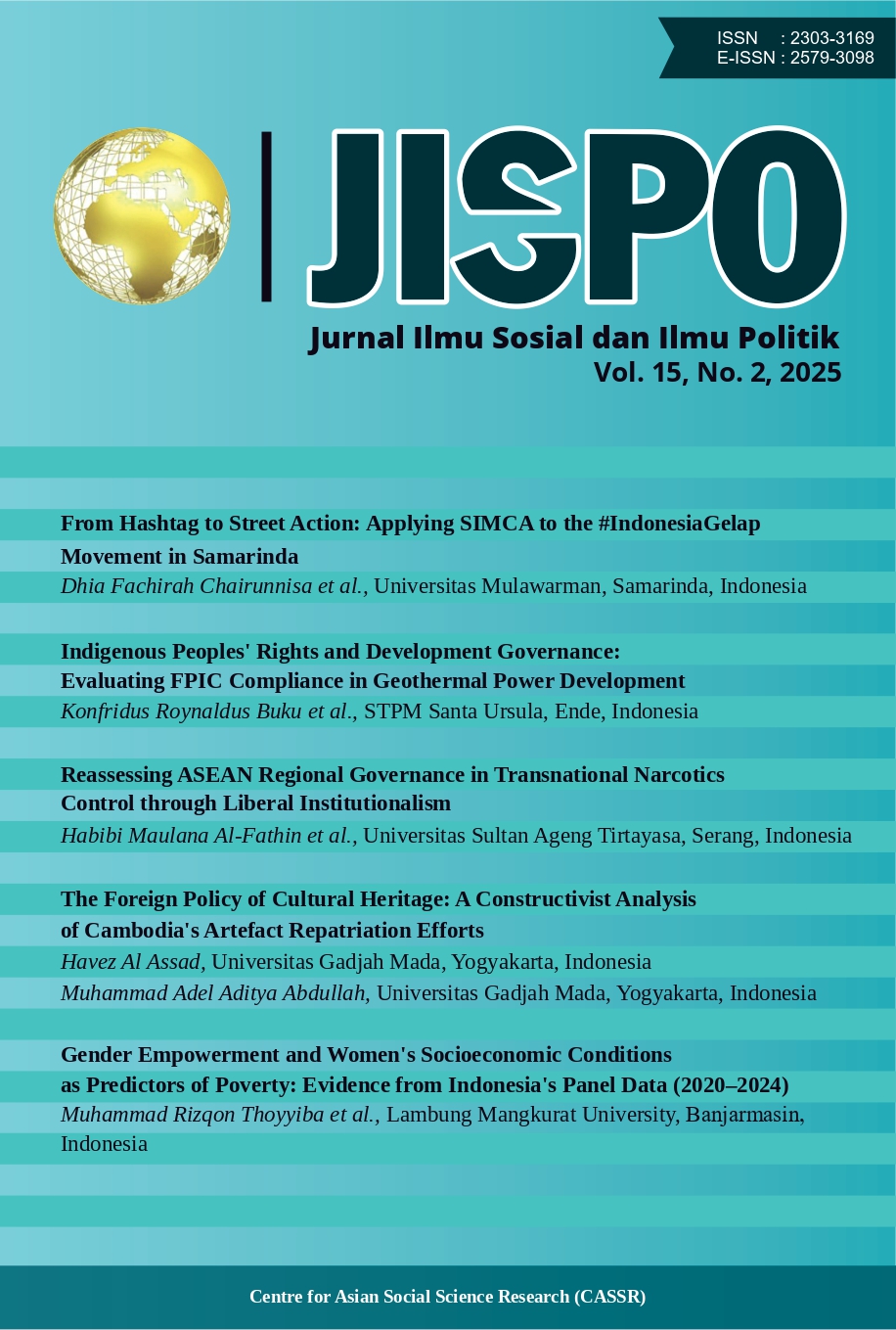
As JISPO closes its 2025 publication cycle, Volume 15 No. 2 arrives at a moment when the language of “development,” “security,” and “participation” is being renegotiated across societies through policy debates, digital platforms, Indigenous struggles over territory, regional institutional cooperation, and even the global politics of cultural heritage. The five articles in this issue share a common preoccupation: how governance is made legitimate (or contested), and how collective claims over welfare, voice, rights, safety, and identity are articulated and institutionalized in contemporary Southeast Asia.
Taken together, this issue underscores a wider shift in social and political inquiry: governance can no longer be understood simply as a state-centred process operating within stable arenas and predictable actors. Instead, it emerges as a multi-level, emotionally charged, and normatively contested field where authority is debated, where data and symbols circulate rapidly, and where “participation” may function either as meaningful inclusion or as procedural cover. These tensions animate each contribution presented here.
The issue opens with “From Hashtag to Street Action: Applying SIMCA to the #IndonesiaGelap Movement in Samarinda,” which examines how digitally mediated contention is translated into offline mobilization. Drawing on interviews, observation, platform content (X and Instagram), and news coverage, the authors frame #IndonesiaGelap not as a fleeting online trend but as a process of meaning-making and coalition-building. Through the lens of the Social Identity Model of Collective Action (SIMCA), enriched by resource mobilization theory and phenomenological concepts of motive and intersubjectivity, the article shows how perceived injustice, moral evaluation, and platform-amplified emotions (anger, outrage, and hope) contribute to solidarity and collective identity. Importantly, the study demonstrates how collective efficacy is produced—not assumed—through open consolidations, coordination among student organizations and civil society groups, and the strategic use of symbolic resources such as hashtags and national imagery. In doing so, it offers a timely reminder that political communication is increasingly inseparable from political organization, as platforms become arenas of affect, identity alignment, and logistical coordination.
Questions of participation and legitimacy take a different form in the second article, “Indigenous Peoples’ Rights and Development Governance: Evaluating FPIC Compliance in Geothermal Power Development.” Here, governance is examined not through protest, but through the procedural and ethical foundations of development itself. Focusing on the Mataloko Geothermal Power Plant (PLTP) in Ngada Regency, East Nusa Tenggara, the authors evaluate the implementation of Free, Prior, and Informed Consent (FPIC)—a principle intended to ensure voluntary decision-making, timely and accessible information, and recognition of Indigenous peoples as legitimate decision-makers in their customary territories. Using a concurrent triangulation mixed-methods design (survey and qualitative inquiry), the study finds that FPIC has not been implemented substantively: communities report restricted decision-making freedom, uneven disclosure of information, and consultation processes that do not sufficiently include all affected groups or respect collective customary procedures. These shortcomings are not treated as minor administrative gaps; they are shown to reshape local social dynamics, producing polarization and strengthening resistance framed as demands for justice and communal rights protection. As Indonesia’s energy transition accelerates and geothermal development expands, this article argues that rights-based safeguards are not obstacles to development, but essential conditions for preventing conflict escalation and sustaining legitimacy.
From local governance and rights, the issue moves to regional cooperation and transnational threats in “Reassessing ASEAN Regional Governance in Transnational Narcotics Control through Liberal Institutionalism.” Addressing narcotics trafficking and abuse as a non-traditional security challenge, the authors examine ASEAN’s governance capacity in the context of the Drug-Free ASEAN 2025 agenda. Grounded in Keohane’s Liberal Institutionalism and based on qualitative literature analysis, the article argues that institutionalized collaboration can persist without hegemonic enforcement through trust, reciprocity, and normative compliance yet requires continuous maintenance to remain effective against adaptive illicit networks. The discussion recognizes progress through ASEAN mechanisms such as ASOD, AMMTC, and ASEANAPOL in facilitating coordination, information exchange, and operational networking. At the same time, it highlights persistent constraints: divergent legal systems, uneven national capacities, inconsistent transparency, and limited joint evaluation and monitoring. The central message is not that ASEAN cooperation is futile, but that regional governance must strengthen implementation linkages, particularly as digital channels transform trafficking markets and operational tactics.
The fourth article broadens the governance lens beyond the region to the international arena: “The Foreign Policy of Cultural Heritage: A Constructivist Analysis of Cambodia’s Artefact Repatriation Efforts.” This study shows how artefact repatriation has shifted from a technical heritage matter into a visible domain of foreign policy, where historical justice and national identity are pursued through diplomatic and legal strategies. Using a holistic constructivist framework and process tracing, the authors argue that Cambodia’s sustained commitment to repatriation is driven less by immediate material gain than by “immaterial structures”: legitimacy, identity, and a “culture of restoration” centred on Angkor. The article maps Cambodia’s hybrid toolkit—mobilizing UNESCO’s 1970 Convention, leveraging bilateral agreements, engaging in legal diplomacy, and cooperating with enforcement and museum actors—illustrating how global norms are localized to reinforce domestic meanings of recovery. In doing so, it highlights heritage diplomacy as a form of soft power and governance practice, with implications for museum ethics, provenance governance, and global restitution frameworks.
The issue closes by returning to a core domain of public policy and social welfare in “Gender Empowerment and Women’s Socioeconomic Conditions as Predictors of Poverty: Evidence from Indonesia’s Panel Data (2020–2024).” Using balanced provincial panel data and a Random Effects specification, the authors show that gender empowerment (GEI) and women’s educational attainment (average years of schooling) are consistently associated with lower poverty levels. This finding reinforces a long-standing but often unevenly implemented policy lesson: expanding women’s capabilities, particularly through education and empowerment, functions not merely as a normative agenda, but as a poverty-reduction strategy with measurable implications across regions. At the same time, the study complicates common assumptions about women’s economic contribution. The positive association between women’s revenue contribution (RCW) and poverty is interpreted as a possible indicator of structural vulnerability, where women’s income share rises amid declining male earnings, precarious employment, or distress-driven work. Meanwhile, female labour force participation appears negative but not statistically significant, underscoring that participation alone is insufficient when job quality, earnings, and security remain weak. In a period marked by overlapping crises and recoveries (2020–2024), the article invites policymakers to treat labour-market indicators with caution and to prioritize empowerment and decent work rather than celebrating participation in the abstract.
Across these five articles, a shared thread emerges: legitimacy is constructed through institutions, narratives, and lived experience, and contested when participation becomes symbolic rather than substantive. Whether in digitally mediated protest, FPIC in energy development, ASEAN’s anti-narcotics governance, Cambodia’s heritage diplomacy, or poverty policy shaped by gendered inequalities, the question is repeatedly the same: who gets to define the problem, who gets to decide, and what kinds of evidence, emotions, norms, and symbols make those decisions acceptable?
We hope this closing issue of 2025 supports readers in thinking across levels—local, provincial, national, regional, and international—without losing sight of the human stakes that animate social and political life. JISPO remains committed to publishing work that is theoretically informed, empirically grounded, and attentive to the changing forms of governance and contestation in Southeast Asia and beyond.
On behalf of the editorial team, we thank the authors for their contributions and the reviewers for their careful, often invisible labour. We invite our readers to engage these articles not only as standalone studies, but as a collective conversation about empowerment and vulnerability, voice and legitimacy, rights and development, cooperation and constraint, and the enduring politics of identity.
Asep Iqbal, Ph.D.
Editor-in-Chief
| People |
| Editorial Team Reviewers |
| Contact |
| Submissions |
| Author Guidelines |
| Reviewer Guidelines |
| Journal Template |
| Copyright Notice |
| Privacy Statement |
| Information |
| For Readers |
| For Authors |
| For Librarians |
Journal Indexing


.jpg)



