
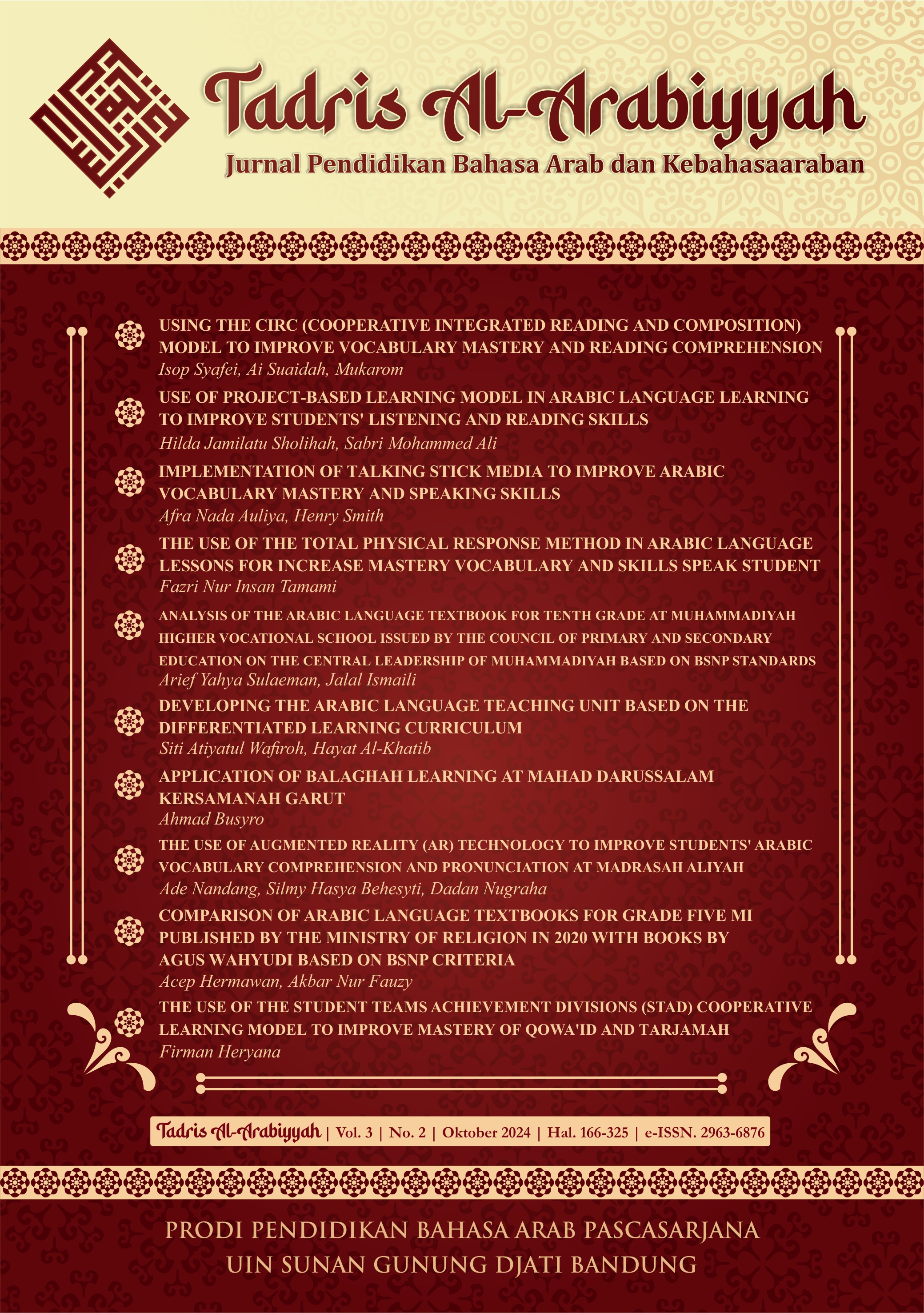
The Use of Augmented Reality (AR) Technology to Improve Students' Arabic Vocabulary Comprehension and Pronunciation at Madrasah Aliyah
DOI:
https://doi.org/10.15575/ta.v3i2.39432Abstract
Arabic teaching faces challenges in improving the quality of education, where students struggle to understand and pronounce vocabulary due to the diversity of vocabulary, which makes the language seem complicated. As a solution to this challenge, augmented reality (AR) technology can be used to make the learning process more interactive and engaging. The purpose of this study is to find out students' understanding of Arabic vocabulary, assess their pronunciation, and learn about the use of augmented reality technology in Arabic language teaching. The method used is a quasi-experimental method with a pre-test and post-test design, with a quantitative approach. Arabic vocabulary comprehension before using augmented reality in the experimental class of class 10B students showed an average score of 66 which indicates a sufficient level, while in the control class class 10A students showed an average score of 63 which also indicates an adequate level. After the use of augmented reality, Arabic vocabulary comprehension in the experimental class of class 10B students showed an average score of 83 indicating an excellent level, while in the control class the students of class 10A showed an average score of 74 indicating a good level. The pronunciation of Arabic vocabulary before using augmented reality in the experimental class of class 10B students showed an average score of 75 indicating a good level, while in the control class of class 10A students showed an average score of 69 indicating an adequate level. After the use of augmented reality, the pronunciation of Arabic vocabulary in the experimental class of class 10B students showed an average score of 89 indicating an excellent level, while in the control class of class 10A students showed an average score of 77 indicating a good level.
References
Asrori, Nur Achmad. “PENGGUNAAN MEDIA GAMBAR DALAM PEMAHAMAN MUFRODAT UNTUK KELAS 3 DI MIN 2 BANYUMAS TAHUN 2022.” UIN Prof, KH Saifuddin Zuhri, 2022.
Amelia Nurhusni, F., & Nugraha, D. (2023). Implementasi Pendidikan Prenatal dalam Upaya Menumbuhkan Kecintaan pada Al-Qur’an. AL-KAINAH: Journal of Islamic Studies, 2(1), 12–27. https://doi.org/10.69698/jis.v2i1.111
Downloads
Published
How to Cite
Issue
Section
Citation Check
License
Copyright (c) 2024 Ade Nandang, Silmy Hasya Behesyti

This work is licensed under a Creative Commons Attribution-ShareAlike 4.0 International License.