
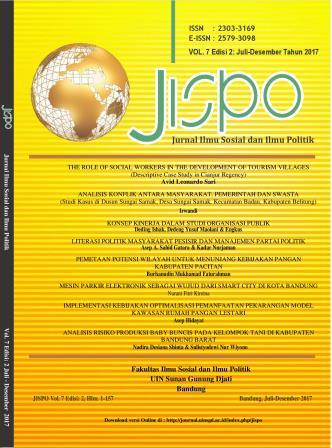
PEMETAAN POTENSI WILAYAH UNTUK MENUNJANG KEBIJAKAN PANGAN KABUPATEN PACITAN
DOI:
https://doi.org/10.15575/jp.v7i2.2271Keywords:
Potential, Area, Food Policy.Abstract
This study aims to provide advice in the form of mapping the area for the development of food policy in Pacitan Regency. Research results through secondary data collection technique of the Central Bureau of statistics the next Pacitan Regency analyzed using techniques scalling indicates that food sweet potato is very well developed in the subdistrict include Donorojo, Pacitan Punung, Pacitan, Pringkuku, Kebonagung, Arjosari, Nawangan, Bandar, Tegalombo and Tulakan. Local government development policy has led to an increase in the food had not yet led to an increase in the availability of plant sweet potatoes along with a town developed. Therefore, the local government needs to devise a policy of pacitan Regency foodstuffs suitable potential regions match the characteristics of the region.
References
Badan Pusat Statistik. 2013. Pacitan Dalam Angka. Pacitan, BPS
Hakim, L., EM. (2011). Pengantar Administrasi Pembangunan. Jogjakarta, Ar-Ruzz Media.
Hanafie, R. (2010). Pengantar Ekonomi Pertanian. Yogyakarta: CV. Andi Offset.
Husnah, M. (2005). Analisis Potensi Daerah Sektor Pertanian Sebagai Pedoman Dalam Pembuatan Perencanaan Pembangunan Pertanian (Studi Kasus di Kabupaten Kediri). Skripsi. Universitas Brawijaya Malang.
Indiahono, D. (2009). Kebijakan Publik Berbasis Dynamic Analisys. Yogyakarta : Gava Media.
Kuswaji, D.P. (2010). Pembangunan Pertanian Berkelanjutan Di Daerah Rawan Longsor Lahan. Universitas Muhammadiyah Surakarta. Diakses pada tanggal 10 November 2014 dari geo.fis.unesa.ac.id/berkas/nask ah/kuswaji.pdf
Prayitno, H. (1987). Pembangunan Tarigan, R. (2012). Perencanaan Ekonomi Pedesaan. Yogyakarta, Pembangunan Wilayah: ed.
BPFE. Revisi. Jakarta, Bumi Aksara.
Produk Domestik Bruto
Tjokroamidjojo B. (1988). Pengantar Kabupaten Pacitan Tahun 2008- Adminitrasi Pembangunan.
Pacitan, BPS. Jakarta, LP3ES.
Rencana Pembangunan Jangka Tjokroamidjojo B., Mustopadidjaya
Menengah Daerah Tahun 2011- A. R. (1988). Kebijaksanaan dan
Pacitan, Bappeda. Administrasi Pembangunan.
Santosa, P. (2008). Administrasi Jakarta, LP3ES.
Publik: Teori dan Aplikasi Good Yustika, E.A. (2002). Pembangunan
Governance. Bandung, Refika dan Krisis Memetakan
Aditama. Perekonomian Indonesia. Jakarta,
Suryabrata, S. (1983). Metodologi Grasindo.
Penelitian. Jakarta, Rajawali. Zauhar, S. (1992). Pengantar Ilmu
Administrasi Negara. Malang:
PPIIS Unibraw
Jurnal
Sampurna, R., & Irwandi, N. (2017). Analisis Kebutuhan Lembaga Penelitian Dan Pengembangan (Litbang) Di Kabupaten Bandung. JISPO : Jurnal Ilmu Sosial Dan Ilmu Politik, 7(1), 1 - 11. Doi:Http://Dx.Doi.Org/10.15575/Jp.V7i1.1731
Dulkiah, M. (2017). Peranan Lembaga Amil Zakat (Laz) Dalam Pemberdayaan Masyarakat Miskin Melalui Pengembangan Usaha Mikro Di Wilayah Jawa Barat. JISPO : Jurnal Ilmu Sosial Dan Ilmu Politik, 7(1), 30 - 49. Doi:Http://Dx.Doi.Org/10.15575/Jp.V7i1.1735
Engkus, N. (2017). Administrasi Publik Dalam Perspektif Ekologi. JISPO : Jurnal Ilmu Sosial Dan Ilmu Politik, 7(1), 91 - 101.Doi:Http://Dx.Doi.Org/10.15575/Jp.V7i1.1739
Downloads
Published
How to Cite
Issue
Section
Citation Check
License
Authors who publish their manuscripts in JISPO agree to the following terms:
- Authors retain copyright and grant the journal right of first publication with the work simultaneously licensed under a Creative Commons Attribution-ShareAlike 4.0 International License that allows others to share the work with an acknowledgment of the work's authorship and initial publication in this journal;
- Authors are able to enter into separate, additional contractual arrangements for the non-exclusive distribution of the journal's published version of the work (e.g., post it to an institutional repository or publish it in a book), with an acknowledgment of its initial publication in this journal; and
- Authors are permitted and encouraged to post their work online (e.g., in institutional repositories or on their websites) after publication process, or prior to and during the submission process, as it can lead to productive exchanges, as well as earlier and greater citation of published work (See The Effect of Open Access).


.jpg)



